
My latest Passion Project
MetaForge Intelli-Tagger: The Intelligent Tagging Tool for Serious Digital Music Collectors

(Over the past month or 3 I’ve been working on this little side-project to help me manage my incredibly large digital music collection. Sharing this for other music geeks like me, just because)
MetaForge Intelli-Tagger is a dual-layer forensic suite designed for collectors who treat their music library as a high-value archive. By unifying automated repair, deep acoustic analysis, and Google’s Gemini AI, MetaForge Intelli-Tagger transforms fragmented collections into a professionally curated, data-rich digital archive that grows in value over time.
MetaForge Intelli-Tagger is built for both surgical precision and massive scale. The workflow is designed to accommodate the remediation of a single, prized digital album or the bulk processing of an entire artist’s discography in a single pass.
(In practice, I am using it at the artist level - I’m something of a completionist and usually seek to have all studio albums by any given artist. Processing a batch of 25 tracks - think Pink Floyd’s The Wall - takes about 35–40 seconds to run through the automated remediation - it’s rate limited to remediate no more than 1 track per 1.3 seconds, because the MusicBrainz API enforces a strict limit of 1 request per second per IP address.)
By automating the repetitive tasks of repair and sanitation while maintaining AI-driven accuracy, MetaForge Intelli-Tagger allows you to process hundreds of tracks with zero loss in metadata quality.
Currently developed for .mp3 music files to align with the ID3v2.3 protocol (which is the industry standard for maximum compatibility across players and hardware), future generations will also support lossless formats such as .flac, for collectors who value that digital format.
The MetaForge Intelli-Tagger Workflow:
1. Structural Health Check & Repair
Upon loading your ‘album’ into the tool, MetaForge Intelli-Tagger performs a “medical” exam of your mp3 files. It identifies and repairs internal corruption, header errors, and truncated data. If a file is critically damaged, it is logged and isolated, ensuring your library contains only healthy, structurally sound audio. (incorporates MP3Val )
2. Clean-Slate Metadata “WhiteList” Scrub
Music files often arrive cluttered with “metadata cruft”: legacy comments, encoded-by strings, and non-standard tags from old software. (I have a Blacklist of that cruft that I have been amassing over 20+ years if ever anyone is interested.) MetaForge Intelli-Tagger executes a surgical strike, wiping away all non-essential data. While individual file size reduction is nominal, removing this dead weight across tens of thousands of tracks results in a measurable reduction in overall library size. (incorporates Mutagen)
Only a strict “Whitelist” of high-value tags is permitted to remain:
Core Identity: Artist, Album, Track Title, and Track Number.
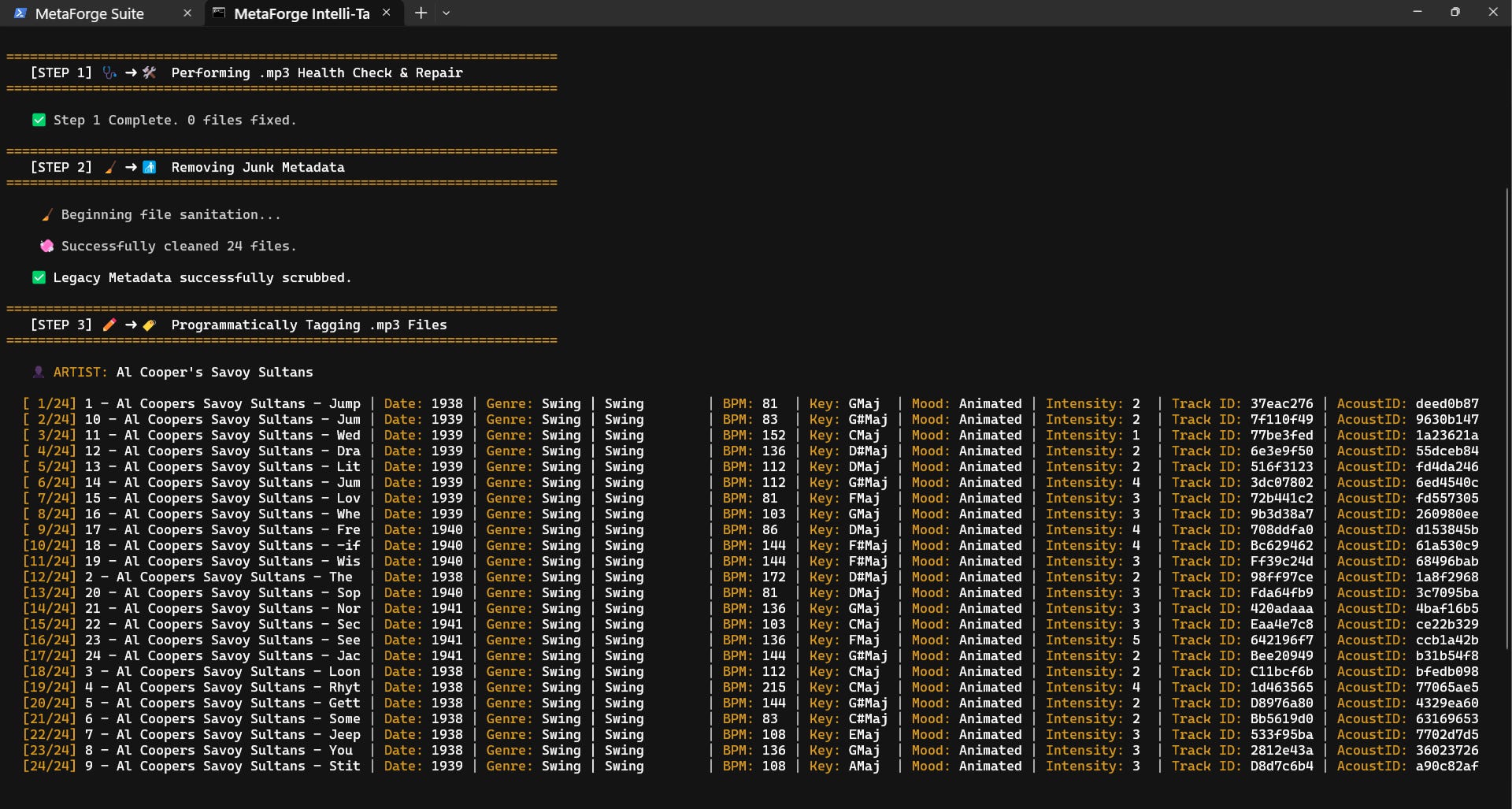
Forensic IDs: Key MusicBrainz Identifiers (Artist ID, Album ID, Track ID) and AcoustID fingerprints (stored as metadata - incorporates fpcalc.)
Acoustic Data: BPM, Musical Key, Mood, and Intensity. (incorporates Librosa)
Archival Metadata: Original Release Year, Record Label, and Personnel credits and some additional Artist data. (scrapes MusicBrainz for whatever is available in those ‘buckets’)
Each of the above values is written directly to the audio file (some of those fields use custom TXXX fields). This ensures your library is not just organized, but unified - free from the conflicting tagging styles and bloat of a dozen different legacy sources.
3. The MetaForge Local Master Database
The biggest value proposition (IMHO) of the MetaForge system is the Local Master Database it creates. (SQLite)
While standard taggers update a file and forget it, MetaForge Intelli-Tagger builds a sophisticated, custom database stored locally on your machine, using the same metadata. This acts as your private “Source of Truth,” housing high-fidelity archival data that exists independently of the music files. By detaching the data from the tracks, MetaForge allows you to curate, explore, and manipulate your library in ways that file-based tagging alone simply cannot support—serving as the foundational architecture for the (Future) Intelligent Playlist Generator.
(This type of indexing is essentially what Plex does today, although my db does not cache images like Plex does - keeping overall file size reasonable. My images are stored as physical assets in the album directory, alongside the .mp3 files, which is pretty standard practice.)
Additionally, because the database is local, your curation remains private and permanent - immune to the shifting metadata or licensing changes of cloud-based streaming services.
4. AI-Powered Taxonomy & Acoustic Analysis
MetaForge Intelli-Tagger utilizes Google Gemini AI to act as a digital musicologist, categorizing your music within a strict, professional-grade taxonomy developed for this project. Simultaneously, the MetaForge engine performs a deep “listen” to every track to calculate, extract and store emotional and technical data based on the Russell/GEMS Hybrid scale—an industry standard for Music Emotion Recognition (MER)).
Acoustic Mood: Classifies the “musical character” into six archival values: Peaceful, Relaxing, Joyful, Animated, Rousing, or Tense. These terms are designed to describe the performance’s intent rather than just its volume.
Intensity Scoring: Assigns a physical energy score from 1 to 10. While the Acoustic Mood describes how the music feels (e.g., Joyful), Intensity measures the “sonic mass” or how hard the music hits.
(This remains an ongoing experiment, and is currently rudimentary if not still fairly accurate.)
Standard shuffle-style playlists often fail because they jump from a high-energy track to a quiet ballad. With 1–10 Intensity Scoring coupled with the Archival Mood taxonomy, the MetaForge Intelligent Playlist Generator will ultimately be able to build a Linear Ramp into your playlist. You can request a 60-minute playlist that starts at an Intensity of 3, peaks at 9 at the 45-minute mark, and cools back down to 4. This level of curated “energy flow” is impossible to create with standard, genre-based tagging today.
5. Visual Verification & Export
As MetaForge Intelli-Tagger processes your audio files, it provides a visual verification of the remediation of those files. You can see – in real time – the remediation process, step-by-step, confirming the work performed and providing total transparency into every surgical remediation step.
(Currently running as Python scripts in Powershell, I am in the process of porting it to a web-based user interface.)
6. Future-State: The Intelligent Playlist Generator
The ultimate goal of this robust metadata/database curation is the planned Intelligent Playlist Generator. Envisioned as more than just a ‘randomizer’, the Intelligent Playlist Generator will use the local database to build the mix with mathematical and logical precision.
(Based on the somewhat obvious conclusion that the better the data, the better the results!)
Because every track is indexed by its fixed Genre and Sub Genre taxonomies, BPM, Key, Mood, and Intensity, you will soon be able to use plain-language AI prompts to generate surgical playlists. Whether you ask for “90 minutes of high-intensity 120 BPM Swing” or “A chill, mellow afternoon set that transitions from Jazz to Soul,” the resulting playlist will hopefully surpass in quality any other tool in the market today.
The Intelligent Playlist Generator is slated for development later in 2026.